


Painted Skin - Chinese New Opera
Production
Overview
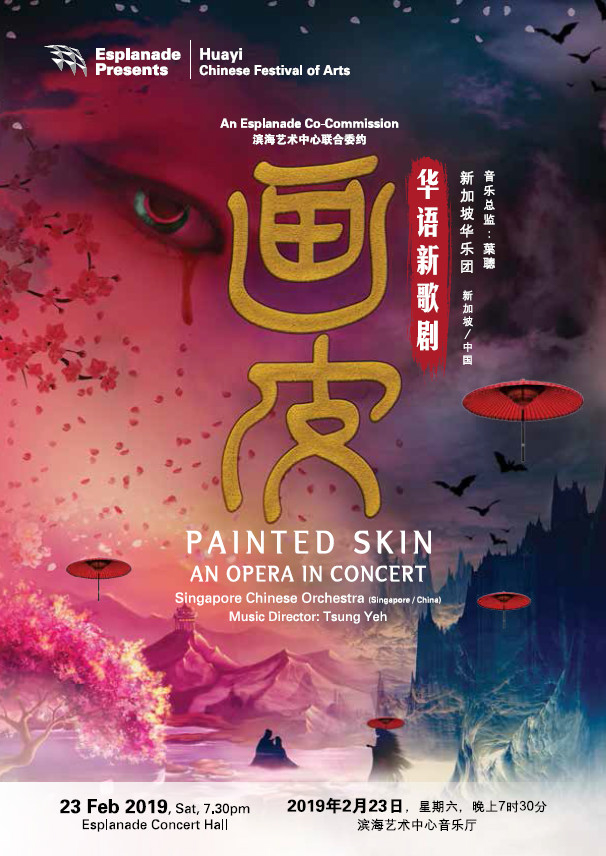
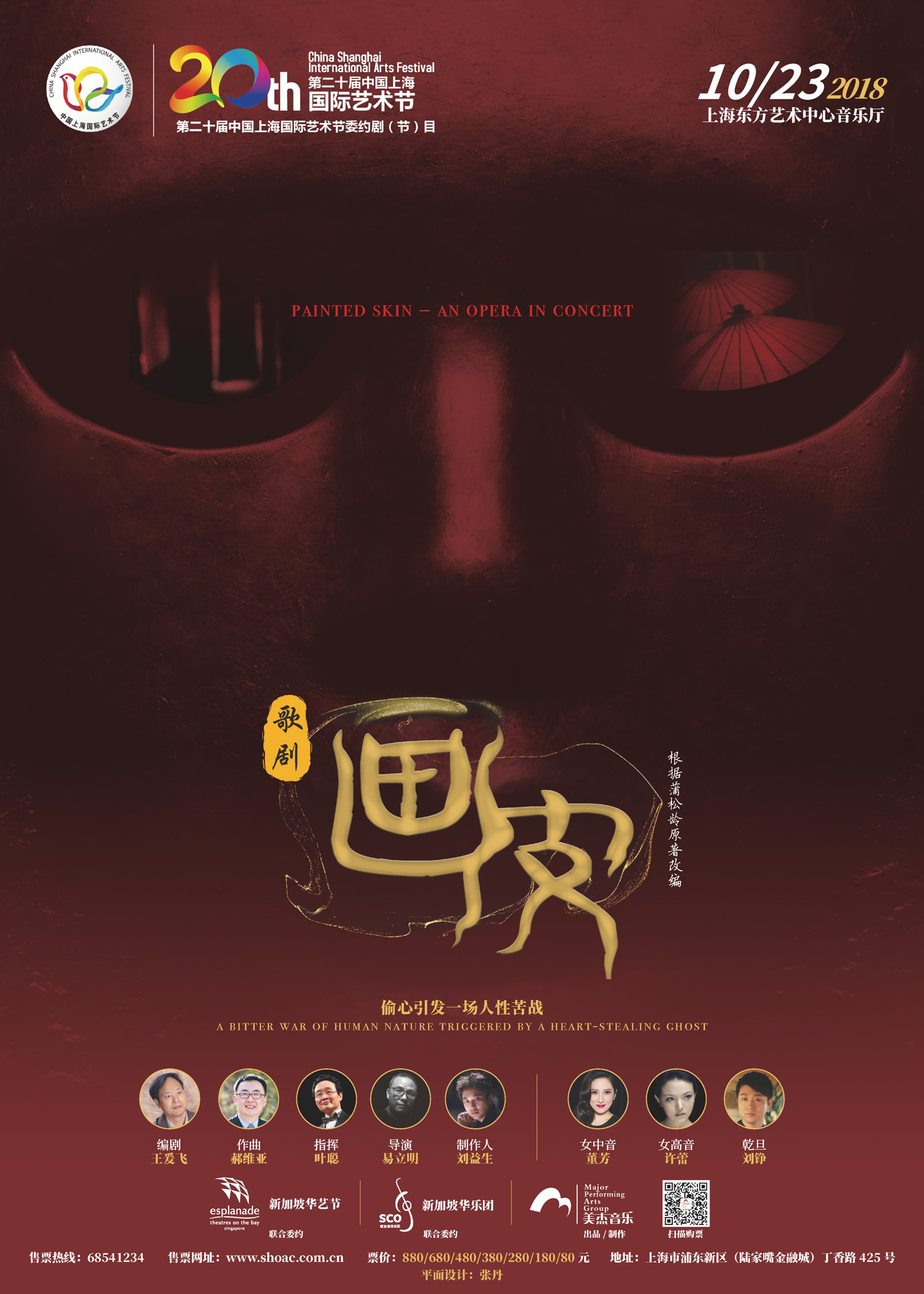
Painted Skin, a new Chinese opera, is composed by Weiya Hao, with libretto by Aifei Wang, direction by Liming Yi, and conducted by Tsung Yeh. Co-commissioned by the China Shanghai International Arts Festival, Huayi – Chinese Festival of Arts (Singapore), and the Singapore Chinese Orchestra, it is co-produced by Major Performing Arts Group and the Chengdu Symphony Orchestra.
Premiered on February 23, 2019, at the Esplanade – Theatres on the Bay in Singapore, the work is adapted from the tale of the same name in Strange Tales from a Chinese Studio by Pu Songling, focusing on the entanglement between humans and spirits and the complexity of human nature. The opera explores a new artistic direction for Chinese contemporary opera, innovating both in form and substance.
Organisers & Casts
Commissioned by:
China Shanghai International Arts Festival
Huayi – Chinese Festival of Arts (Singapore)
Singapore Chinese Orchestra
Produced and Presented by:
MAJOR Performing Arts Group
Composer: Weiya Hao
Director: Liming Yi
Producer: Yisheng Liu
Conductor: Tsung Yeh
Librettist: Aifei Wang
Artistic Vision
The opera positions itself as an exploration of the genre of Chinese New Opera. Musically, it employs contrapuntal techniques to shape distinctive Chinese melodies, enabling the orchestra to become a narrative voice rather than a mere accompaniment. The score is written for a Chinese chamber orchestra to highlight the delicacy and humanistic tone of traditional Chinese instruments.
Conductor Tsung Yeh developed a unique conducting style that integrates Tai Chi and martial arts gestures, enriching the flow and expressive quality of the music in a distinctly Chinese manner. The orchestra’s dialogue-like responsiveness and tonal color were meticulously refined.
Vocally, the opera breaks away from conventional bel canto technique. Drawing inspiration from traditional Chinese opera, it employs “cut-tone articulation” and forward projection to meet the clarity demands of Chinese diction. The singing seeks rawness and dramatic intensity, expressing inner turmoil with greater emotional resonance.
Structure & Narrative
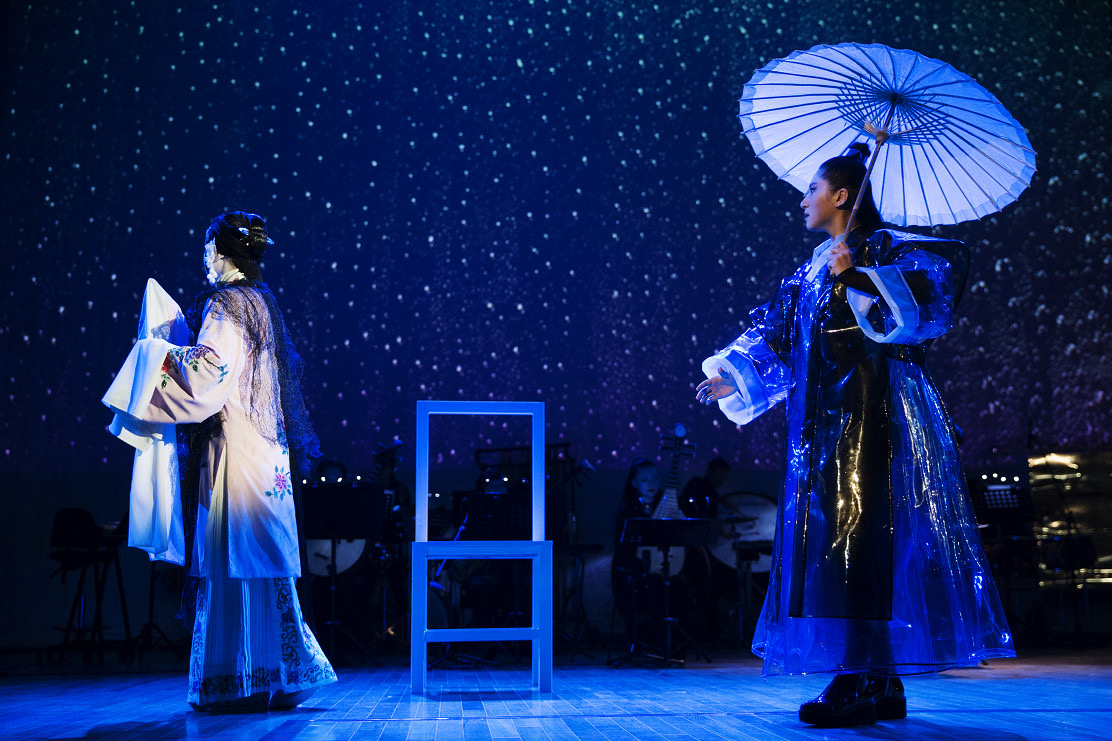
The libretto is divided into four acts — Lending the Umbrella, Returning the Umbrella, Playing with the Umbrella, and Breaking the Umbrella — with the umbrella serving as a symbolic thread throughout.
It tells the story of a scholar, Wang Sheng, who lends his umbrella to a weeping woman in the rain, unaware that she is a vengeful ghost wearing a “painted skin.” This act unfolds a story of emotional entanglement between the living and the dead, raising moral questions and probing human desires.
Through minimalism, symbolic imagery, and emotional conflict, the opera delves deeply into the themes of desire, true affection, deception, and resolution.
Visual & Sonic Aesthetic
Director Liming Yi blends traditional Chinese opera movements with modern expressionist physicality. The stage design follows the principle of scattered perspective and intentional emptiness — featuring only a single chair as a symbolic space, channeling the audience’s focus toward the performers and their inner emotional landscape.
The music is performed live by a Chinese chamber orchestra of about 20 musicians, using primarily traditional Chinese instruments. Composer WeiYa Hao emphasizes the delicacy and humanity of Chinese instrumental sound, making sound itself a central narrator of the drama.
Gallery
Innovative Cross-Cultural Practice in Chinese New Opera
Taking Painted Skin as a Case Study
Musical Innovation: Fusion of Traditions
Composer Weiya Hao bases his writing on Chinese folk instruments, using counterpoint techniques to construct a polyphonic texture. The orchestra is elevated from background accompaniment to an expressive and dialogic protagonist.
The opera employs a 20-member Chinese chamber ensemble, avoiding reliance on Western symphonic orchestras, offering a more intimate and refined sonic palette. The result is a compelling fusion of folk tone color with chamber music sensibility.
Conductor Tsung Yeh restructured and reassembled the orchestral parts during rehearsals to encourage polyphonic awareness. His pioneering “Tai Chi conducting method” abandons fixed Western downbeats in favor of fluid, expressive gestures, embodying the Chinese aesthetic of musical “flavor” and flow. This method opens new possibilities for conducting pedagogy and operatic rehearsal systems.
Vocal Language: East–West Dialogue
The opera defies traditional Western bel canto singing. To enhance diction clarity and dramatic expressiveness in Mandarin, the performers draw on techniques from Chinese opera, such as syllabic articulation and forceful projection, aligning with the rhythmic and tonal characteristics of the Chinese language.
When needed, performers adopt raspy, grainy, or forward-projected timbres to express despair, loneliness, or inner conflict — bridging the expressive gaps of traditional operatic techniques. The libretto draws on the rhyme and cadence of Kunqu Opera, combining classical refinement with contemporary expressivity, resulting in a hybrid vocal identity between Chinese opera and Western bel canto.
Stage Aesthetics: Eastern Body and Modern Minimalism
Director Liming Yi rejects elaborate sets in favor of a single chair, following the visual principles of Chinese traditional painting — namely, scattered perspective and negative space. Actor movements borrow heavily from Chinese opera’s stylized gestural vocabulary, reinterpreted through an expressionist lens.
This minimalist stage concept releases the full expressive tension of music and the human body, encouraging the audience to “complete the visuals with imagination.” The aesthetics of intentional emptiness (留白) echo the spiritual essence of Chinese art and stand in stark contrast to the realism and spectacle of Western opera.
Narrative Structure and Identity Reconfiguration
Librettist Aifei Wang structures the script into four symbolic acts—each centered on the umbrella, representing the entanglement between human and ghost. Though based on Painted Skin from Strange Tales from a Chinese Studio, the story incorporates contemporary perspectives on desire, isolation, and identity.
Painted Skin – Chinese New Opera
Cast
- Mezzo-soprano Dong Fang plays the male scholar Wang Sheng
- Soprano Xu Lei plays Wang’s wife
- Liu Zheng, in the traditional Qundan (male-enacts-female) role, plays the ghost Gui Yan
- This creates a Mezzo–Soprano–Qundan triadic structure, challenging traditional gender roles and inviting new readings of character and humanity.